Which Is Better Coffee Maker or French Press
Choosing between a coffee maker and a French press depends on your taste preferences and lifestyle. A French press offers a rich, full-bodied flavor, while a coffee maker provides convenience and speed. Consider factors like grind size, extraction time, and health aspects. A French press's minimal health impact contrasts with concerns about cholesterol in unfiltered coffee. Ultimately, your choice should reflect your daily needs and taste desires. Investigate further to uncover which brewing method best suits you.
Key Takeaways
- French press offers a rich, full-bodied flavor, while coffee makers can vary from bold to mild depending on the machine and settings.
- French presses require manual effort and attention, whereas coffee makers can automate the brewing process for convenience.
- Unfiltered French press coffee can increase LDL cholesterol, whereas filtered coffee from machines may be healthier for heart health.
- French presses are generally more affordable but require more preparation time compared to quick, automated coffee makers.
- Stainless steel French presses are durable, while coffee makers offer various features and capacities to suit different lifestyle needs.
Extraction Methods Explained
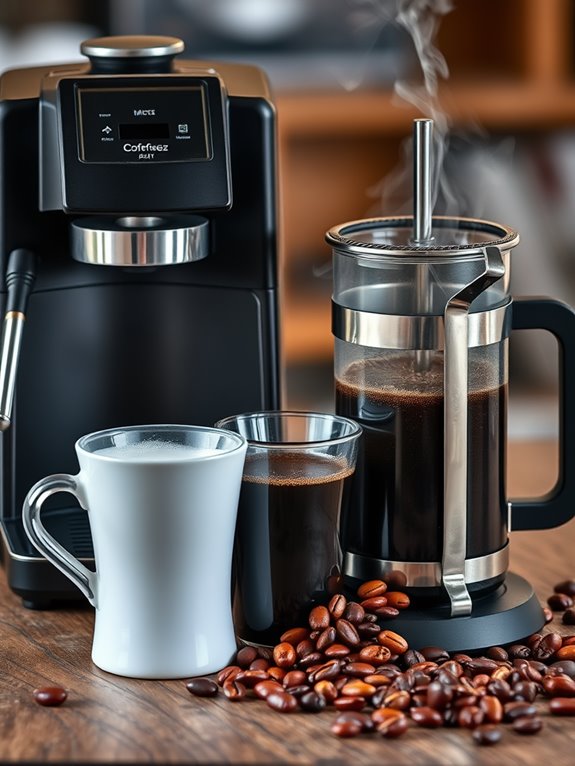
When it comes to understanding coffee extraction methods, you'll find it's a fascinating blend of science and art. The French Press uses an infusion technique, similar to tea, where you pour water at about 95°C over coarse coffee grounds. Let it infuse for four minutes, ensuring an even saturation. This method results in a full-bodied and slightly cloudy coffee, offering a wider aromatic range compared to other brewing techniques. In contrast, espresso involves pressurized hot water pushed through fine grounds in phases: acids, oils, and bitters, taking 20-30 seconds. The grind size matters significantly in each brewing method, with espresso requiring the finest grind for optimal extraction. Drip brewing percolates hot water through grounds in a filter, starting with blooming to release gases. Each method varies in process and equipment, shaping your coffee experience. Let's investigate these methods further.
Flavor Profile Differences
Investigating the flavor profiles of different coffee brewing methods opens up a world of taste possibilities.
When using a French press, you'll enjoy a rich, full-bodied flavor thanks to the immersion technique and stainless steel filter, which keeps coffee oils intact. This method delivers a less acidic, thicker brew with a pronounced aroma.
In contrast, methods like Chemex yield a brighter, cleaner cup, highlighting the acidity of beans. Each method, from Aeropress with its fruity notes to espresso's bold intensity, brings unique taste experiences.
Let's examine how grind size, extraction time, and filter types shape these distinct flavors.
For optimal pour-over results, maintain water temperatures between 195°F and 205°F to achieve the fullest flavor extraction.
Design and Operational Considerations
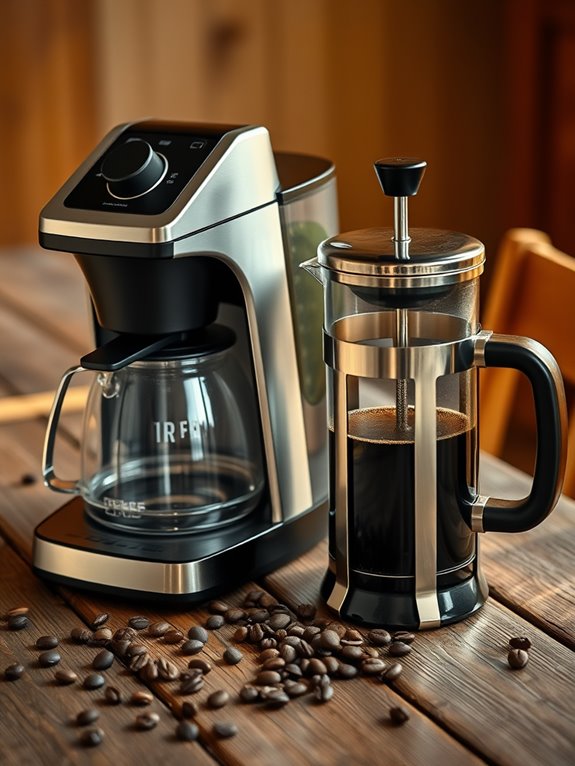
Understanding the design and operational considerations of a French press can greatly enhance your coffee brewing experience.
Let's investigate the materials: stainless steel French presses offer durability and heat retention due to double-walled construction, while glass ones are prone to breaking but aesthetically pleasing.
In terms of ergonomics, look for full-length handles and secure lids for ease of use. Plunging should feel smooth, and certain designs make cleaning a breeze, with many being dishwasher safe.
Different capacities cater to various needs, so choose one that fits your lifestyle. The manual brewing process requires more attention and effort compared to automatic coffee makers, making it less ideal for busy mornings. With these observations, you're equipped to choose a French press that suits you perfectly.
Health and Safety Aspects
While savoring a cup of coffee brewed in a French press offers a pleasing experience, it's important to contemplate the health and safety aspects of this brewing method.
Unfiltered coffee, like that from a French press, contains cafestol and kahweol, which can raise LDL cholesterol levels, potentially impacting heart health.
Let's investigate safety concerns: coffee makers can harbor bacteria and mold if not cleaned regularly, posing risks. Regular maintenance, using cleaning capsules, helps prevent contamination.
Though French press coffee has minimal health impact compared to lifestyle choices, those with cardiovascular concerns might prefer filtered coffee for a healthier option.
Manual brewing methods require more attention to cleaning and maintenance compared to automated machines with self-cleaning cycles.
Cost and Preparation Time Analysis
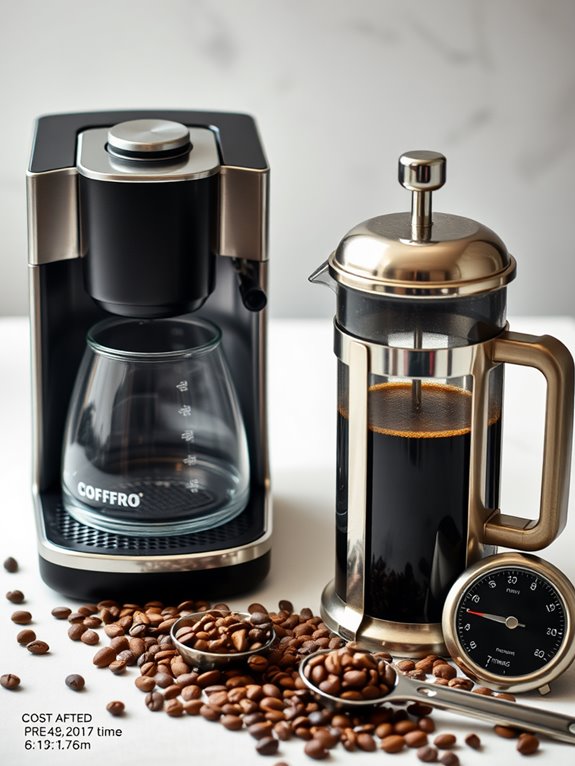
When deciding between a French press and a coffee maker, cost and preparation time are key factors to evaluate. French presses, like the Bodum Chambord, are affordable at $36.99, with entry-level options as low as $25. Premium models reach $99.95. Preparation takes about 4:30 minutes. Coffee makers, however, vary widely in price, generally starting at $20. They often automate processes, potentially saving you time, but specific preparation times differ per model.
| French Press | Coffee Maker | Notes |
|---|---|---|
| Entry Price: $25 | Starts at $20 | French press is affordable |
| Brew Time: 4:30 min | Varies | Manual vs. automated processes |
| Bodum Chambord $36.99 | High variability | French press offers value for money |
| Premium $99.95 | Up to $200+ | Price range varies widely |
| Replacement $15+ | Not specified | Additional French press costs |
User Preferences and Use Cases
Why do people choose a French press over a coffee maker, or vice versa? It boils down to your preferences and lifestyle. The French press offers control and flexibility, letting you customize the brew to suit your taste.
On the other hand, a coffee maker provides convenience and consistency, perfect for busy mornings or when serving a crowd.
Let's investigate key considerations:
- Control: French press lets you adjust water temperature and steep time, perfect for experimenting.
- Convenience: Coffee makers provide hassle-free brewing, ideal for large gatherings.
- Environment: French press is eco-friendly, minimizing waste with its filter-free design.
Expert Recommendations and Quality Assessments
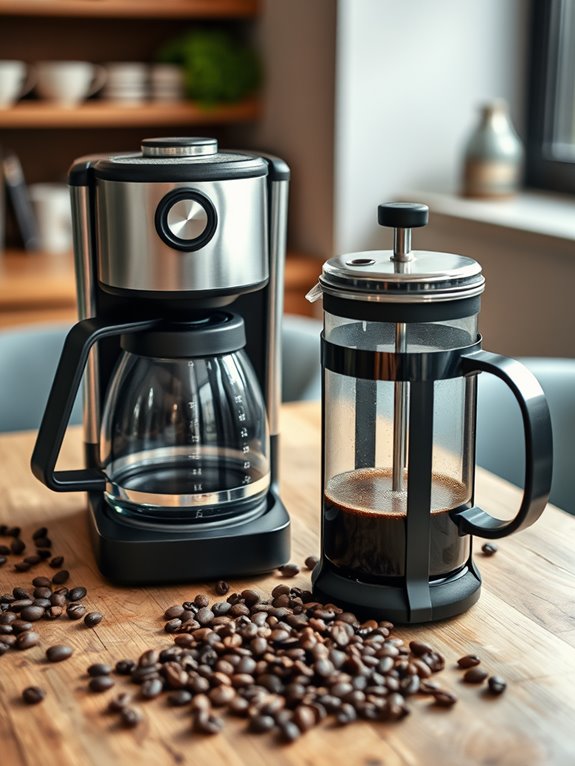
As you consider your options between a coffee maker and a French press, expert recommendations and quality assessments can be indispensable in guiding your decision. French presses, like the Espro P7 and YETI Rambler, are lauded for their material quality and brew richness. Stainless steel construction guarantees durability, while effective filters provide a smooth coffee experience. Lab tests confirm these models excel in taste and durability, maintaining ideal brewing temperatures. Let's investigate these key features further:
| Feature | Espro P7 | YETI Rambler |
|---|---|---|
| Material | Stainless Steel | Stainless Steel |
| Brew Quality | Rich, Flavorful | Less Sediment |
| Heat Retention | Excellent | Average |
Choosing the Right Option for You
How do you decide between a coffee maker and a French press for your daily brew? Let's examine the key factors to contemplate.
First, think about the flavor profile you prefer:
1. Strong and Flavorful: French press offers hearty taste with some sediment.
2. Mild and Clean: Coffee maker provides a smoother, cleaner cup.
Next, evaluate your environmental impact:
– French press is more eco-friendly, avoiding paper filters.
Finally, weigh cost and value:
3. Budget-Friendly: French press is generally cheaper and offers long-term savings.