Why Was the Coffee Maker Invented
Let’s investigate why the coffee maker was invented. It aimed to simplify and improve the coffee-making process, offering a quick, convenient way to brew a consistent cup every time. By introducing filters and mechanisms like drip systems, coffee makers guaranteed sediment-free, flavorful drinks. They changed daily routines, making delicious coffee more accessible than ever. Inventions like the percolator and drip coffee maker revolutionized coffee preparation, promising more advancements and understanding into this beloved beverage’s evolution.
Key Takeaways
- Coffee makers were invented to simplify and standardize the coffee brewing process for consistent flavor and quality.
- The invention aimed to remove coffee grounds from the final brew, enhancing clarity and taste.
- Innovations like the percolator and drip coffee makers emerged to streamline coffee preparation.
- Coffee makers offered convenience and speed, making coffee more accessible for daily consumption.
- The development of various coffee makers catered to evolving consumer preferences for different coffee strengths and flavors.
Origins of European Coffee Consumption
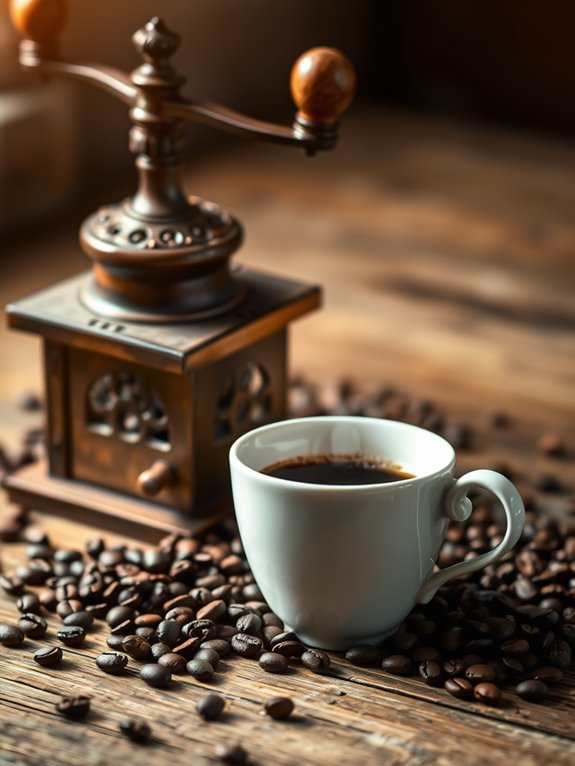
When we talk about the origins of European coffee consumption, it’s vital to understand how this beloved beverage first made its way into Europe and captured the hearts of its people.
Coffee’s expedition began in 1526 when the Turks introduced it to Hungary. By 1529, it reached Vienna during the Siege of Vienna. The drink spread further in 1565, brought to Malta by Turkish slaves. Coffee then gained scholarly attention in 1575 through Charles de l’Ecluse’s writings. Coffee houses became central to public life in Islamic cities, facilitating public engagement and paving the way for similar establishments in Europe.
Early Innovations in Coffee Brewing
Investigating the early innovations in coffee brewing reveals a fascinating journey of creativity and ingenuity.
Let’s examine how early inventors altered coffee making.
In the 17th century, Europeans began using cloth or metal filters to separate grounds, leading to cleaner brews.
Siphon and vacuum methods were patented in the 1830s, utilizing steam for a cleaner taste.
By 1884, the first espresso machine was patented, revolutionizing coffee culture.
These innovations laid the groundwork for more sophisticated brewing techniques.
Consider these early developments:
- Cloth filters for sediment-free coffee
- Siphon brewers for visual appeal
- Steam-powered espresso machines
- Continuous evolution of brewing methods
The pursuit of perfect coffee continued with pour-over methods emerging as an important technique for extracting optimal flavor from quality beans.
The Birth of the Percolator and Drip Coffee Maker
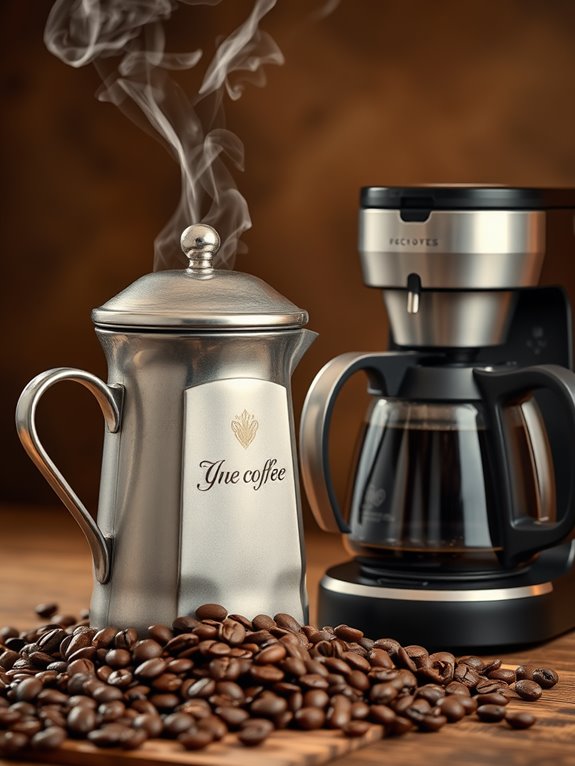
While many appreciate a good cup of coffee, few know the fascinating history behind two of its most iconic brewing methods: the percolator and the drip coffee maker.
Let’s investigate how these innovations changed coffee brewing forever.
The Percolator Revolution
Sir Benjamin Thompson invented the percolator in the 1780s.
His design cycled boiling water through coffee grounds repeatedly, achieving the desired strength.
This continuous brewing was pioneering.
The Rise of Drip Coffee
In 1908, Melitta Bentz altered coffee brewing with her drip coffee maker.
Using a blotting paper filter, she created a smoother, sediment-free drink.
Her invention became the foundation of modern drip brewing, transforming coffee preparation.
Today’s coffee enthusiasts can enjoy 100% Arabica beans in various roasts from light to dark, maintaining the rich heritage of these brewing methods.
The French Press and Its Influence
Although many coffee enthusiasts mightn’t realize it, the French press has a rich history and significant influence in the world of coffee brewing. You can trace its origins back to 1852 when Mayer and Delforge patented its precursor.
The modern design you know today was perfected by Swiss inventor Faliero Bondanini in 1958.
Let’s investigate:
- The French press is known for its simple yet efficient brewing method.
- Its global names include “coffee plunger” and “cafetiere.”
- It pairs well with rich, smoky coffee roasts.
- Approximately 2.5 million French presses are sold annually in the United States.
For the best French press results, a ceramic burr grinder ensures consistent grounds that enhance the brewing process.
Introduction of Instant Coffee
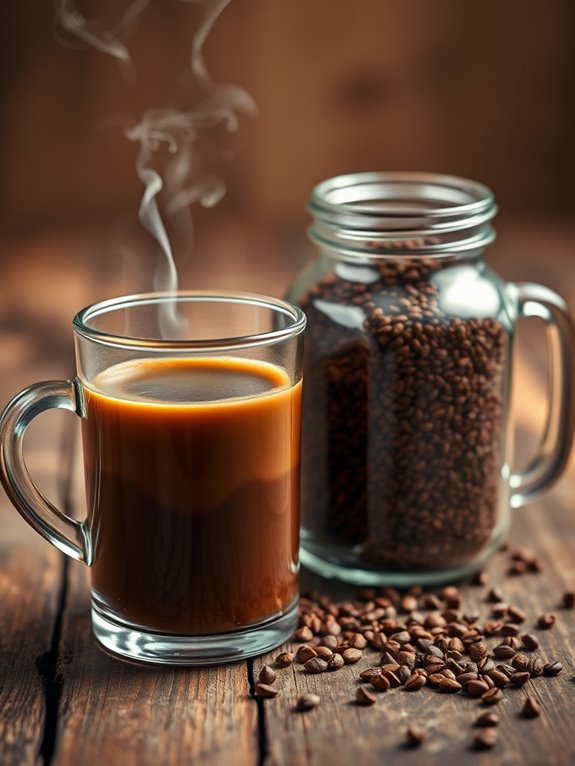
Let’s investigate the fascinating voyage of instant coffee, a revolutionary invention that changed how people enjoy their daily caffeine fix.
Initially patented in Britain as a “coffee compound” in 1771, instant coffee’s expedition continued with David Strang’s “soluble instant coffee” in 1890.
Dr. Satori Kato further propelled this innovation by creating a stable coffee powder in 1901.
George Washington revolutionized its mass production in 1909.
Technological advancements like freeze-drying and spray-drying have enhanced flavor and preservation.
Instant coffee gained prominence during World Wars, providing soldiers with a convenient caffeine source, and continues developing with modern packaging and flavor innovations.
Today’s instant coffee products like Folgers Classic Roast deliver rich, smooth taste while offering up to two years of shelf life when unopened.
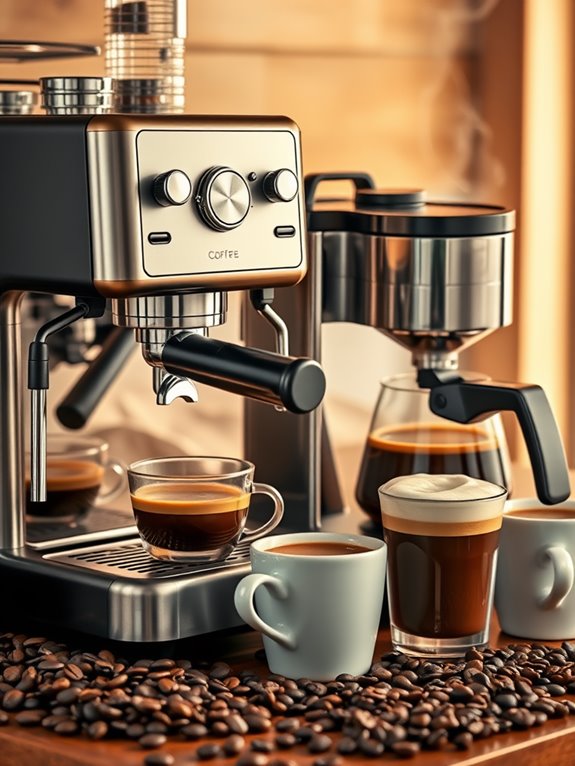
Evolution of Espresso Machines
Espresso machines, a cornerstone of coffee culture, have a rich history of innovation that has altered how people enjoy their daily brew.
It all started in 1822 with Louis Bernard Rabaut’s creation. By 1855, Edouard Loysel de Santais showcased a machine capable of brewing 2,000 cups per hour.
Angelo Moriondo’s 1884 invention, patented in Turin, laid the groundwork for modern machines. Luigi Bezzera’s 1901 patent refined these designs, ushering in the commercial era.
Let’s investigate key advancements:
- Pressure Control: Crucial for perfect espresso extraction.
- Temperature Stability: Guarantees consistent brewing.
- Steam Wand Technology: Enhances milk texture.
- Digital Interfaces: Simplifies operation.
Modern Coffee Brewing Technologies
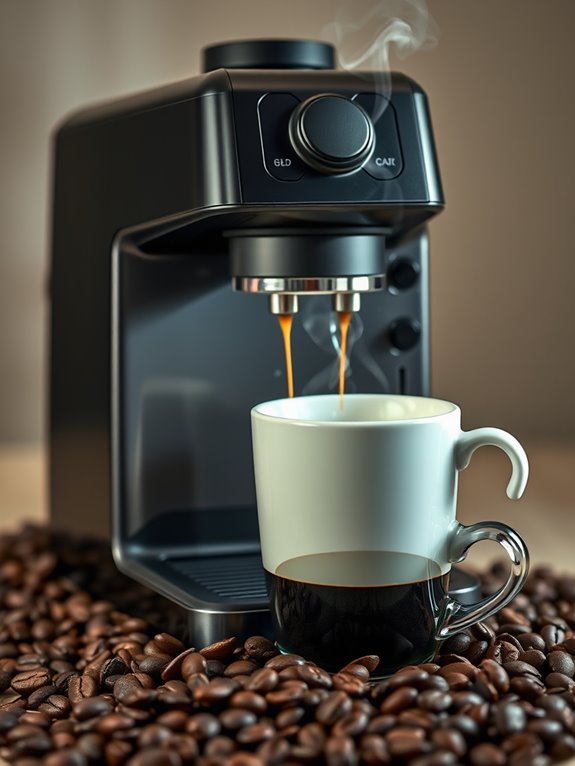
When it comes to modern coffee brewing technologies, there’s a lot to investigate, from drip brewing to portable options.
Drip brewers remain popular due to their ease, offering automated features like precise water heating for a quick brew.
For those who prefer precision, manual methods like the pour-over let you control variables, extracting subtle flavors without residue.
Single-serve options, such as the AeroPress, provide portability and full-flavored coffee on the go.
Looking ahead, coffee machines are advancing with increased automation, IoT integration, and sustainability features, ensuring you can brew your perfect cup with ease and minimal environmental impact.