Can a Regular Coffee Grinder Be Used for Espresso
Let's investigate whether a regular coffee grinder can be used for espresso. You can technically use one, but it typically lacks the precision needed for fine, consistent grounds. Espresso demands a specific grind size for ideal extraction. Coffee grinders often can't achieve this due to less adjustability and improper burr design. For quality shots, espresso grinders provide more precise, even grinds. Keep going to learn about the differences and how they impact flavor.
Key Takeaways
- Regular coffee grinders can be used for espresso but may lack precision for optimal grind size.
- Espresso requires a fine, consistent grind for proper extraction and flavor balance.
- Coffee grinders often lack the necessary adjustability and burr design for espresso.
- Espresso grinders offer precise adjustments and burr types for ideal espresso quality.
- Using an espresso grinder ensures consistent particle size and better extraction.
Understanding the Differences Between Coffee and Espresso Grinders
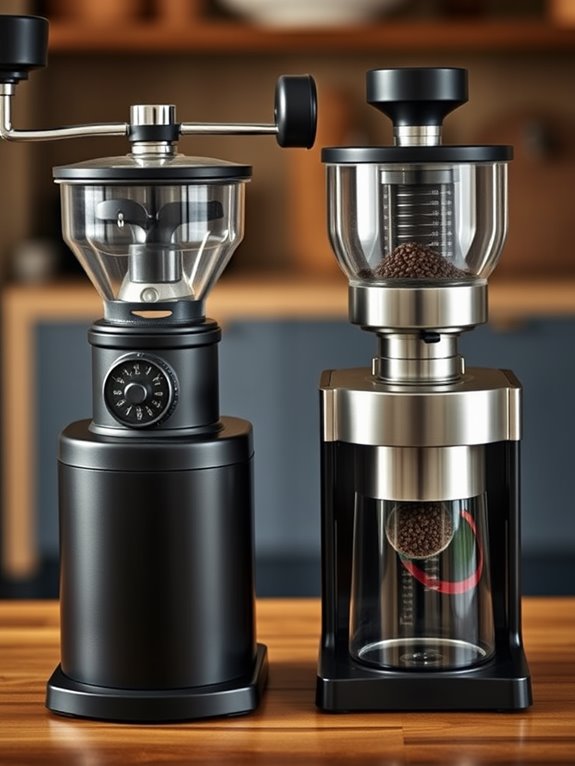
When it comes to brewing a perfect cup, understanding the differences between coffee and espresso grinders is vital.
Espresso grinders are designed specifically for fine grinding, essential for creating the rich, concentrated flavor of espresso. These grinders typically use flat or conical burrs, providing a consistent and fine grind. To achieve the pinnacle of espresso brewing, it's crucial to focus on the taste as a primary factor in choosing the right grinder.
In contrast, coffee grinders offer adjustable grind sizes for methods like drip coffee or French press. While versatile, they often use blade or conical burrs, not optimized for espresso's fine grind. Multiple grind settings are essential for achieving the desired consistency across different brewing methods.
Espresso grinders focus on precision, featuring advanced settings, yet they require more maintenance due to the finer grind and bean oils.
Exploring Grind Size and Its Impact on Espresso
Investigating the intricacies of coffee and espresso grinders highlights the importance of grind size in crafting the perfect espresso shot. A fine grind is essential; it offers resistance yet allows water flow. If too fine, expect bitterness; too coarse, and sourness prevails. Adjusting for bean type, roast level, and humidity is key. Stainless steel burrs ensure consistent grind size and optimal flavor extraction in quality espresso grinders. Let's examine grind sizes:
| Grind Size | Brewing Method | Impact on Flavor |
|---|---|---|
| Fine | Espresso | Strong, bold, creamy |
| Medium | Drip Coffee | Balanced, subtle |
| Coarse | French Press | Rich, full-bodied |
| Medium-Fine | Aeropress | Smooth, slightly strong |
| Super-Fine | Turkish Coffee | Intense, sturdy |
Adjust regularly for ideal espresso!
Examining Burr Design and Its Importance for Espresso
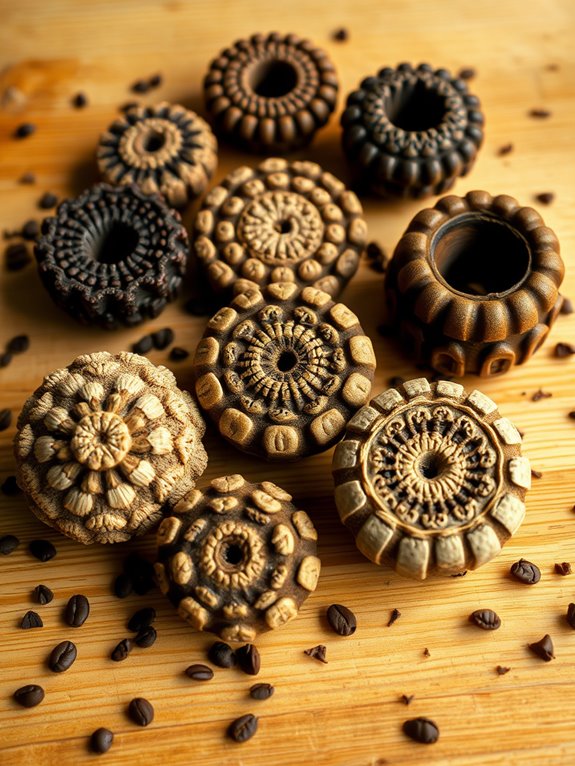
Understanding the design of burrs in coffee grinders is vital for crafting exceptional espresso. Let's investigate why.
Burr types, either flat or conical, play an important role in grind consistency. Flat burrs, common in commercial settings, offer consistent grinds, but they can heat up. Conical burrs, often found in home grinders, create more fines, enhancing flavor.
The geometry and alignment of burrs are essential for even particle distribution, impacting taste. Larger burrs require precise alignment to avoid inconsistency.
Materials, like durable metal or heat-retaining ceramic, affect performance. Your choice of burr design influences the final espresso quality greatly.
Quality burr grinders like the Shardor Conical Burr offer 51 precise grind settings to achieve the perfect espresso consistency.
The Role of Adjustability in Achieving the Perfect Espresso Grind
To achieve the perfect espresso grind, adjustability is essential, allowing you to fine-tune the grind size for ideal extraction and flavor balance.
Espresso demands precise control over grind size, as even small deviations can lead to over or under-extraction. Burr grinders, especially those with stepless adjustments or at least 40 settings, are highly recommended for this purpose.
You'll need to frequently tweak your grinder due to changes in ambient conditions, like temperature or humidity, and factors such as bean age and roast level.
Let's investigate how understanding these elements helps you achieve consistent, high-quality espresso every time.
The conical burr design delivers superior consistency in grind size, making it the preferred choice for espresso enthusiasts.
Assessing the Compatibility of Coffee Grinders for Espresso
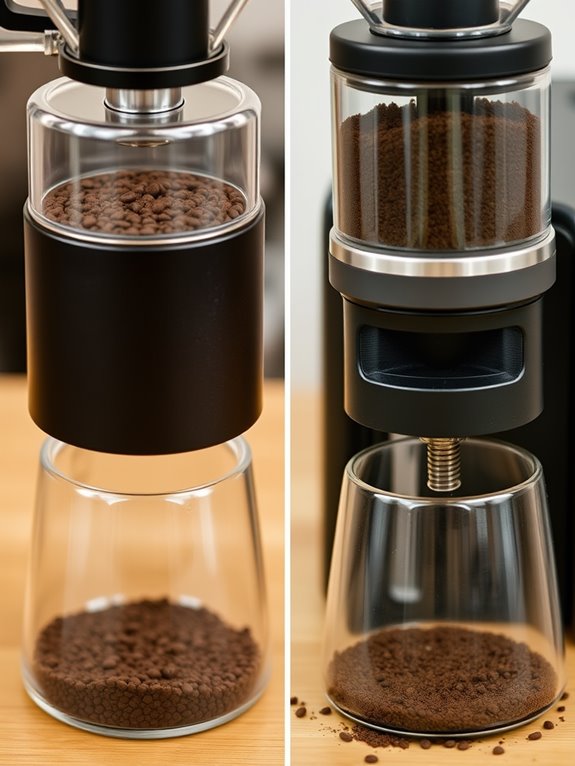
When you're evaluating the compatibility of coffee grinders for espresso, it's vital to understand the unique demands of espresso brewing.
Espresso requires a fine, consistent grind, usually between 180 and 380 microns. Regular coffee grinders, designed for versatility, may not achieve this precision, leading to poor extraction.
Espresso grinders are specifically crafted to handle high-pressure brewing, ensuring a uniform grind texture. This is fundamental to prevent issues like channeling or uneven extraction.
So, while a regular grinder might suffice for other brewing methods, achieving true espresso quality demands a grinder customized to meet these specific requirements.
Let's investigate your options carefully.
The Significance of Burr Grinders in Espresso Quality
Although it might seem like any grinder could suffice, burr grinders play a vital role in achieving the quality and consistency essential for espresso. By using burr grinders, you get a uniform grind size, which is important for extracting rich, balanced flavors.
Let's examine why burr grinders are your go-to for espresso:
- Precision Cutting: Their sharp teeth minimize ultra-fines, ensuring even extraction.
- Flavor Control: Adjust grind size easily to manage bitterness or sourness.
- Consistency: No excess heat is generated, preserving the coffee's aroma.
- Adjustability: Fine-tune the grind for various espresso methods.
With burr grinders, every cup is a work of art!
Key Features and Benefits of Espresso Grinders
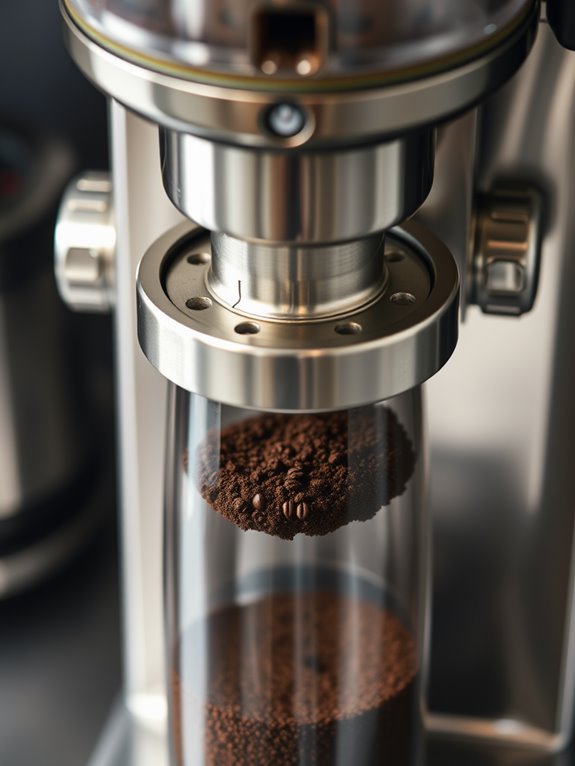
Espresso grinders possess key features and benefits that greatly enhance your coffee experience, making them indispensable tools for any coffee enthusiast. Let's investigate their core attributes. Grind precision is paramount; these grinders offer multiple settings for perfect espresso, adapting to changes in conditions. Freshly ground beans guarantee superior flavor, as oils remain intact and oxidation is minimized. The design prioritizes ease of use, often incorporating durable materials like stainless steel.
Here's a quick glance at key benefits:
| Feature | Benefit |
|---|---|
| Grind Precision | Consistency and adjustability |
| Quality and Flavor | Richer, aromatic brews |
| Design Considerations | Durability and ease of use |
| Operational Considerations | Freshness and reduced waste |
Choosing the Right Grinder for Your Espresso Needs
Before selecting the perfect grinder for your espresso journey, it's important to understand what sets espresso grinders apart.
Burr grinders are your best bet because they offer consistent and uniform grinds, essential for that rich espresso flavor. Blade grinders, on the other hand, can make your coffee taste off due to uneven grinds.
Let's examine key considerations:
- Grind Consistency: A fine, uniform grind guarantees perfect extraction.
- Speed and Heat: Low-speed grinders preserve coffee's natural flavors.
- Durability: Look for materials like stainless steel or ceramic for longevity.
- Precision Adjustments: Stepless adjustments allow fine-tuning for perfect espresso.